
Tracing Former Lincoln County Owners
Work backward from the newest deed. Carry the legal description alongside every name you collect. The County Clerk's online landing page lists its recording categories but publishes no historical cutoff. The depth of that index stays an open question. FamilySearch fills part of the gap with a dated catalog. That catalog covers deed books, grant books, and indexes. A separate reconstructed record set speaks to the title papers lost in the 1909 fire. That set matters most once the chain reaches the courthouse's burned years.
| Source | Years It Covers | Where Held | What It Shows |
|---|---|---|---|
| WV Land Records index | Online cutoff not published | Lincoln County Clerk portal | Current recording categories; result row not captured |
| Deed books and indexes | 1825–1910 books; indexes 1825–1968 | County records and FamilySearch catalog | Earlier conveyances and party names |
| Grant books | 1854–1929 and 1967 | County records and FamilySearch catalog | Grant entries; image access varies |
| Destroyed-title papers | Pre-1909, reconstructed 1910–1914 | Commissioner’s records, volumes 1–3 | Replacement evidence for lost land records |
| Recorded plats | Specific years not listed | County Clerk Plat Maps category and GIS | Lot, block, and subdivision descriptions |
Begin a former-owner search in the Clerk's present index, which covers recent transfers. For older entries, work through the catalog's date ranges. Request any book or image that is not open online. Land that predates Lincoln County's creation in 1867 may sit in predecessor-county records instead. The Lincoln County recording index and the historic catalog each serve a different era. Together they cover the full span of the property records.
The Lincoln County WV Land Records page lays out the deed and land-instrument categories. These categories anchor a former-owner search.
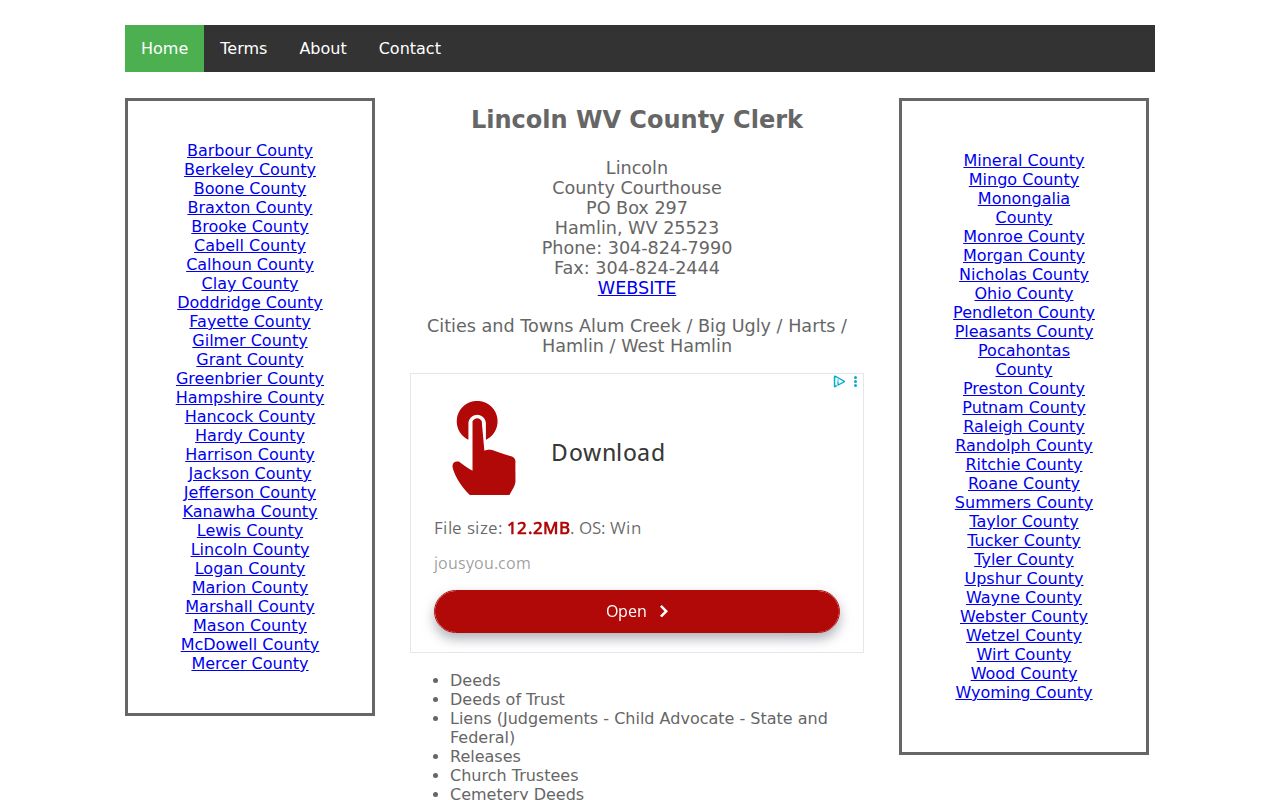
That category list is only the modern entry point.
Walking Back Through Lincoln County Deeds
A Lincoln County deed chain reads best backward. Treat each recorded transfer as the search key for the next one. A deed names the grantee who received an interest and the grantor who conveyed it. So search both names in the County Clerk index and compare the land wording every time. Names drift between entries. Initials change. Spellings shift, married names appear, and trustees or entities show up under capacity labels that hide the person behind them. The current owner page stays fixed on the present roll. This route instead follows each earlier recorded transfer, parcel by parcel. It reaches into the county's deeper deed records.
- Find the latest deed for the parcel and note the grantee and legal description.
- Read the grantor and search that name as an earlier grantee.
- Compare dates, book/page or document reference, and the same land description.
- When the online result ends, move to cataloged books and reconstructed records.
- Grantor
- The party conveying the interest in a deed.
- Grantee
- The party receiving the interest.
- Chain of title
- The ordered sequence of recorded transfers for the same land.
- Legal description
- The lot-and-block or metes-and-bounds wording that helps match land across old records.
Lincoln County Predecessor Deeds
Lincoln County formed in 1867 from territory tied to Boone, Cabell, Kanawha, and Putnam counties. A tract conveyed before that date may sit in a predecessor's books. It might not be in the Lincoln index at all. Use the deed's legal description and the family names involved to guess the older jurisdiction. Then ask that clerk or archive about its grantor and grantee books. This is a boundary-of-time problem as much as a name search. A modern address often does not exist in the older record. The parcel description may lean on a creek instead. It might cite a ridge, an adjoining landowner, or a lot number. Keep those words intact when you compare a deed against a later map or assessment card. The 1867 formation works as a checkpoint in any long chain. Search the Lincoln books back to the point where the tract's history crosses that line. Then identify which predecessor jurisdiction handled that date and place. Boone, Cabell, Kanawha, and Putnam all appear in the county's formation history. A neighboring index may hold an earlier instrument. That can be true even when the modern parcel sits entirely inside Lincoln County. Write the historical county and source beside every citation. Older deeds describe land by courses, distances, and watercourses. Ridges and adjoining owners may define the tract instead. A road address plays no part. A name match without matching land language proves nothing. Keep a short abstract of the parties and the date. Add the book or instrument reference and the boundary wording. That habit keeps the next search on track. It follows the property, not a stranger with a similar name.
Lincoln County’s Fire and Title Papers
The 1909 courthouse fire destroyed Lincoln County land records to that time. A replacement courthouse opened in 1911, and the modern courthouse was completed in 1964. The key substitute is the Commissioner’s record of destroyed title papers, pre-1909, volumes 1–3, reconstructed from 1910 to 1914. Those books are a search lead, not a claim that every lost deed survived.
Use the current Clerk index first, then the reconstruction and the relevant deed book or predecessor-county file. The FamilySearch Lincoln land catalog describes the historic holdings and access notes.
The FamilySearch catalog screen points to the land books used in a Lincoln County house-history search.
Access comes with conditions. Some catalog images require a library, an account, or a visit to a FamilySearch Center. Record agreements restrict others. The cataloged deed-book run for the county begins in 1825. The surviving originals from before the fire are incomplete. The grant books and indexes carry their own date ranges. Never treat one series as covering for another. A gap between an 1890s reference and a 1910s deed can mean several things. The fire may explain it. So may a reconstructed title paper, an older jurisdiction, or an instrument filed in a different record category. Ask the Clerk or archive which volume applies before concluding the chain has ended. House research rewards combined sources. A deed establishes a recorded transfer. Probate explains why an heir or administrator appears. A marriage index can connect names across documents. Library collections sometimes add community context too. Label each conclusion by source. Local-history clues should never get confused with a legal transfer or a verified boundary.
How Far Lincoln County Former Owners Go
How deep do Lincoln County property records reach? The County Clerk publishes no starting year for its online index. So the portal's earliest coverage stays unstated. FamilySearch fills some of that gap. Its catalog lists deed books from 1825 to 1910. It also shows grant books covering 1854 to 1929 plus 1967, and indexes spanning 1825 to 1968. Those dated spans open a real route into older Lincoln County property records. Still, some items cannot be viewed remotely, and not every transfer appears in the collection.
Research the land, not a living person. Former-owner work is useful for house history, a title question, or property diligence. Do not use a Lincoln County deed chain to follow, expose, or harass a person.
Lincoln County Probate Chain Changes
An estate can interrupt a neat person-to-person chain. Lincoln County probate begins with an appointment through the County Clerk. A will file requires the original will, beneficiary contacts, photo ID, and any bond the will does not waive. An intestate filing requires an estate bond, full heir contact details, and the proposed administrator’s photo ID. These files can explain why an executor, administrator, heir, or estate buyer appears in a later deed.
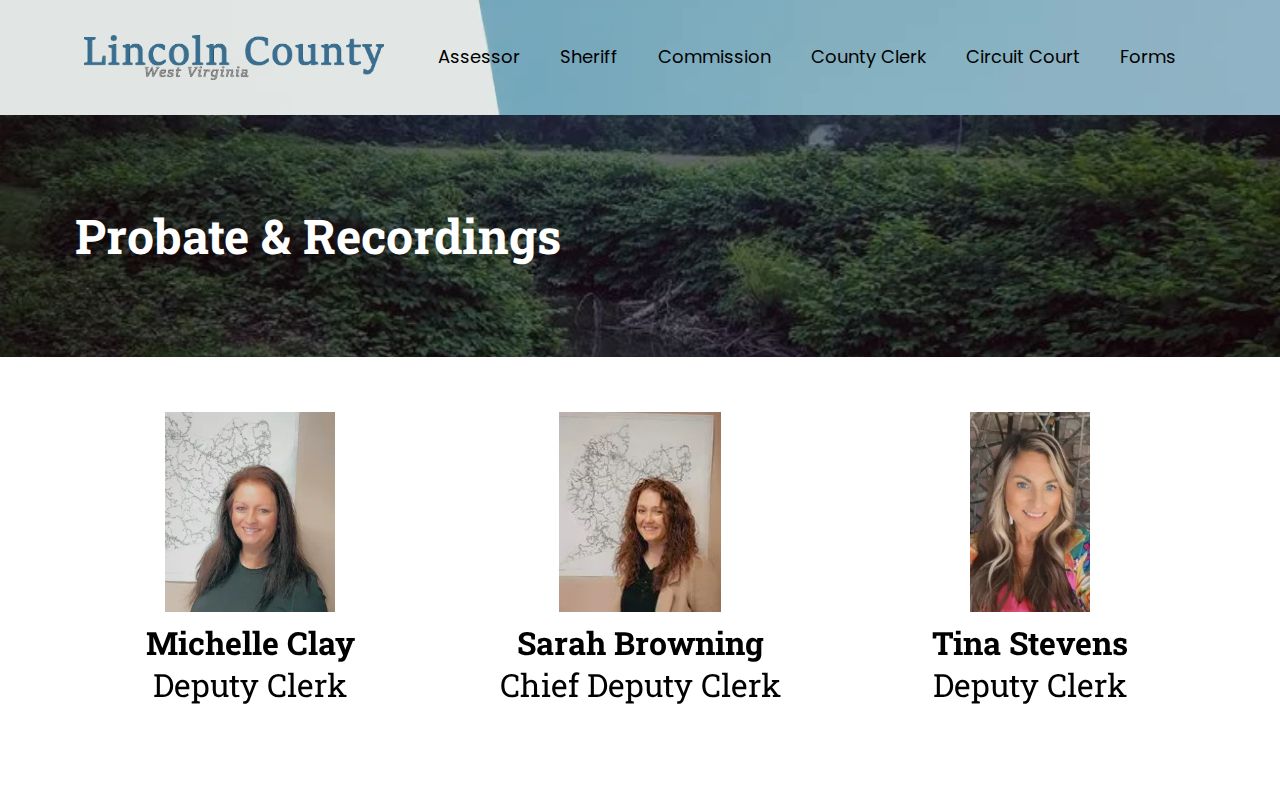
The County Clerk’s probate and recordings page gives the appointment instructions. Match an estate file to the deed by the party names and property description. Probate helps explain the transfer; the recorded deed remains the instrument that changes the land record.
The county Probate & Recordings page shows the local route for estate appointments that may explain an older Lincoln County owner transition.
Identify the estate file first, then compare its names and land description with the recorded conveyance in the deed.
Lincoln County Family Record Leads
Marriage and family records can help connect names when a deed chain changes through marriage, inheritance, or estate work. The statewide West Virginia marriage collection covers 1780–1970 and includes Lincoln County. It is a family-history lead, not proof of land ownership. Some images need an account or are restricted, and the catalog warns that county year coverage varies.
The West Virginia marriage index is searchable by names and dates. Use it to support identity research, then return to the deed, probate, or recorded plat for the property connection.
The West Virginia marriage collection screen shows the name-search route for Lincoln County family records.
A family record explains a name change, never a transfer.
Lincoln County Library House History
The Hamlin-Lincoln County library system is a local fallback when online indexes stop. Its research page points to WV InfoDepot, and the system serves Hamlin, Alum Creek, and Guyan River. The official material does not list exact newspaper years, city directories, obituary runs, yearbooks, cemetery files, or licensed genealogy databases. Ask a librarian what can be consulted before assuming a collection exists.
The library’s history records a Hamlin storefront opening in 1972, a Branchland addition in 1978, and the move that formed Guyan River in 2015. The library research page is the contact route for local sources that might place a family or house in context.
The Hamlin-Lincoln County library research page points readers to current local research resources.
Ask about the specific item and year range before counting on it.